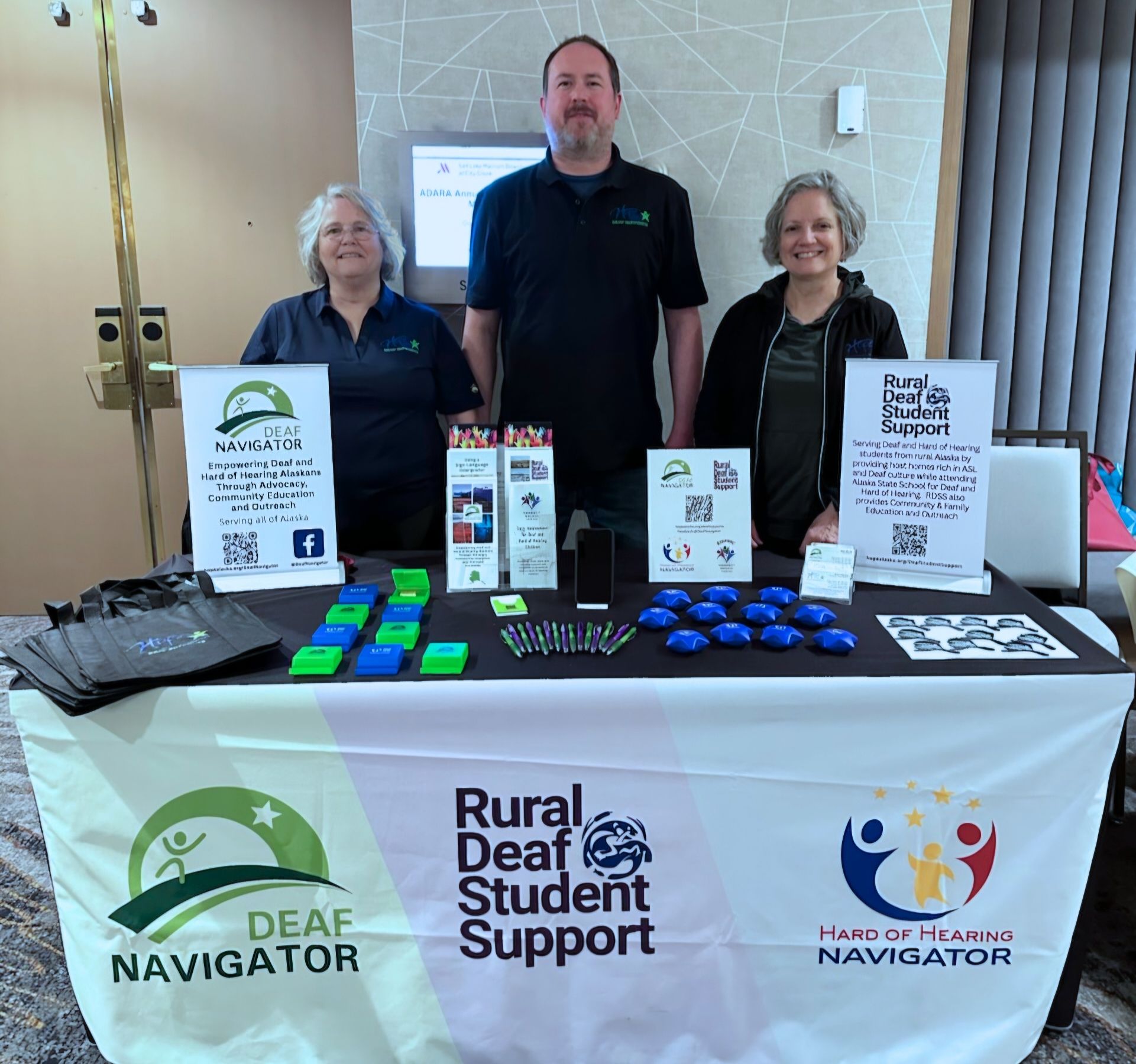
(Pictured above: Judy Lange, Michael Merritt, Sharon Miranda)
Hope Community Resources' Deaf Supports Team offers support and services to Deaf and Hard of Hearing individuals in a manner that is free of cultural or language barriers. Our staff members in Deaf Supports are fluent in American Sign Language (ASL) and well-versed in Deaf culture. We have extensive experience working with deaf adults and children of many cultures and communities, from Anchorage to very remote parts of Alaska.
Deaf Supports Programs and Services
Our Deaf Supports Team offers several programs and services to support the Deaf and Hard of Hearing communities in Alaska. Discover how our programs can make a difference in your life!
Rural Deaf Student Support Program
Deaf Navigator Program
Hard of Hearing Navigator Program
Early Involvement for Deaf and Hard of Hearing Children
Upcoming Deaf Supports Events
Join us for one or more upcoming events designed to empower and connect the Deaf and Hard of Hearing community in Alaska. Whether you're looking to network with others or simply have a good time, our upcoming events offer something for everyone. Stay tuned for details on event dates, locations, and how to participate.


Jekyll & Hyde: The Musical
October 16 - November 1 (ASL Interpreted Performance October 24)


Deaf Culture Terminology
When it comes to terminology, it's impossible to create a definitive rule that is acceptable to everyone. In most cases, an appropriate label depends on how the person identifies him/herself, rather than a specific degree of hearing loss. It is preferable to use a specific term - Deaf, deaf, or hard of hearing.
Deaf (with a capital "D")
- This is a reference to members of the Deaf community and Deaf culture.
- They are proud to be Deaf and feel that Deafness is a vital part of their identity, cherished as much as ethnicity, gender, and religious background.
- People in this cultural group most likely attended residential schools for the deaf, use American Sign Language (ASL,) and view Deafness as a difference rather than a disability.
- Deaf people often feel a cultural bond with one another based on sharing a common language and experience oppression.
- Although they most likely recognize ASL as their primary/native language, they may or may not use speech to communicate.
deaf (with a lowercase "d")
- This is a general term which encompasses many groups of people, most of whom do not identify themselves as being part of the culturally Deaf community.
- People who are "deaf" are usually oral deaf people who use speech and residual hearing to communicate instead of sign language.
- This definition varies in different regions, but it usually is connected to people with severe or profound hearing loss who choose to associate mainly with hearing people.
Hard of Hearing
- This is usually a term for people with mild, moderate, or severe hearing loss.
- Hard of hearing people often use speech as their primary mode of communication, but may be involved in the Deaf community.
- This group of people usually can transition back and forth between the Deaf and hearing cultures.
- Hard of hearing people often form advocacy groups of their own, due to their special communication needs which are overlooked due to misconceptions about hearing loss.
Hearing Impaired
- This term is considered highly offensive. Just as "deaf-mute" and "deaf and dumb" are inappropriate labels, "hearing impaired" is an outdated way to collectively label people with any level of hearing loss. It does not account for cultural identity.
- The use of "hearing impaired" may be considered less blunt by many hearing people, but within the Deaf community, it is an insulting term and can be a sign of ignorance.
Hearing
- This is a label for people who have no hearing loss.
- "Hearing culture" is the mainstream American culture which is primarily focused on auditory experiences rather than visual experiences.
Alaska Children's Books in ASL
We invite you to watch and share this collection of children's books in ASL. Perfect for young readers and their families, these videos offer an immersive and accessible way to enjoy Alaskan tales.
Mama Do You Love Me?
Alaska's Three Little Pigs
The Giant Cabbage: An Alaska Folktale
Patsy Ann of Alaska
Sitka Rose
Anna Across the Arctic
Watch previous years' Deaf Awareness Week videos:
- Alaska News Source: Deaf Awareness week kicks off with their 'Passport to the Deaf World'
- Andrew Foster, ATLA, AKSD
- Nathie Lee Marbury, AKRID, ADC
- Sharon Ann Dror, SESA, RnR Interpreting
- Sanzan Tani, DDC, SSG
- Dummy Hoy, J&D Interpreting, Plexus
- Hope Community Resources, Division of Vocational Rehabilitation, Oneida
- Riækt Consulting, Mat-Su Borough School District, Ninestar Education, ASL Storybook: "Boy", Program for Infants & Children
Interpreting Services
Learn more about working with certified ASL interpreters, and contact local interpreting services below.
Choice Access Interpreting
Contact: Jamie Hartung
Phone: 907-531-7445 (voice/text)
Email: [email protected]
www.choiceaccessinterpreting.com
Alaska Interpreting Alliance
Contact: Kathleen Bodolay
PO Box 2088
Palmer, Alaska 99645
Cell (voice & text): 907-982-2751
Fax: 907-745-7446
Email: [email protected]
RNR Interpreting
Contact: Shawn Schramski
PO Box 222504
Anchorage, AK 99522
Voice: 907-317-2235
Videophone: 907-531-9733
Text: 907-830-9855
Email: [email protected]
Additional Resources
ASL: Don't Fall for Employee Retention Credit Scams
Resource: IRS Videos ASL
Dated: June 21, 2023
988 Suicide & Crisis Lifeline - ASL Services
Network of crisis contact centers that offer many services for people who are Deaf and Hard of Hearing, including veterans.
5259 Deaf & Hard of Hearing Drug Rehab Centers
Specialized addiction treatment programs for the deaf and hard-of-hearing with ASL support and trauma-informed care.
Deaf and Hard of Hearing Experiences in Healthcare Survey
If you are Deaf, DeafBlind, Hard of Hearing, or Late-Deafened and over 18, we invite you to share your healthcare experiences in an important research study.
Hands United
Supporting immigrant families with children who are Deaf or hard of hearing to connect and grow with their child.
Contact Us
Hope Community Resources, Inc.
Physical Address: 3500 E. 20th Ave., Anchorage, AK 99508
Mailing Address: 540 W. International Airport Rd., Anchorage, AK 99518
Videophone: 907-268-4416
Fax: 907-272-8807
Email: [email protected]
Additional Services Provided by Hope
Residential Living ServicesBehavioral & Mental Health SupportsChild & Family SupportsFoster Care & Family HabilitationFinancial Services